

#include <iostream>
using namespace std;
class Base {
public:

  virtual void f() { cout << "Base::f" << endl; }

  virtual void g() { cout << "Base::g" << endl; }

  virtual void h() { cout << "Base::h" << endl; }

  int age;
};

class Derive: public Base {
public:

  virtual void f() { cout << "Derive::f" << endl; }

  virtual void h() { cout << "Derive::h" << endl; }
};

int main()
{
  Base b1;
  Derive d1;

  {
    // 1、vptr在age成员之前, 为std::size_t字节
    cout << "Base 对象的地址:" << (void*)&b1 << endl;
    cout << "Base 对象member的地址:" << (void*) &b1.age << endl;
    cout << "sizeof vptr:" << (uint8_t *) &b1.age - (uint8_t*)&b1 << endl;
  }

  std::cout << std::endl;

  {
    // 2、vtable的地址, vtable => std::size_t* vtable[N];
    cout << "Base 对象 vtable member的地址:" << *(std::size_t *)&b1 << endl; // b1->vtable 10进制打印
    cout << "Base 对象 vtable member的地址:" << (void *)*(std::size_t *)&b1 << endl; // b1->vtable 16进制打印

    cout << "Derive 对象 vtable member的地址:" << *(std::size_t *)&d1 << endl; // d1->vtable
    cout << "Derive 对象 vtable member的地址:" << (void *)*(std::size_t *)&d1 << endl;
  }

  std::cout << std::endl;

  {
    // 3、分别打印基类、子类vtable中函数地址打印
#define MemberFunNums 3
    typedef std::size_t* Vtable;
    typedef void(*FuncOfVtable)();

    Vtable base_table = nullptr;

    base_table = (Vtable)*(std::size_t *)&b1;
    for (auto i = 0; i< MemberFunNums ; ++i) {
      FuncOfVtable vFuncPtr = (FuncOfVtable)base_table[i];
      std::cout << (void*) vFuncPtr << std::endl;
      vFuncPtr();
    }

    base_table = (Vtable)*(std::size_t *)&d1;
    for (auto i = 0; i< MemberFunNums ; ++i) {
      FuncOfVtable vFuncPtr = (FuncOfVtable)base_table[i];
      std::cout << (void*) vFuncPtr << std::endl;
      vFuncPtr();
    }
  }

  return 0;
}
#include <iostream>
#include <functional>

using namespace std;

class Base {
  public:

    int a;
    virtual void g() {
        cout << "Base::g" << endl;
    }

    virtual void h() {
        cout << "Base::h" << endl;
    }

    virtual void f() {
        cout << "Base::f" << endl;
    }

};

class Derive : public Base {
  public:

    int a;

    void print() {
        cout << "print" << endl;
    }
    virtual void f1() {
        cout << "Derive::f1" << endl;
    }

    virtual void f() {
        cout << "Derive::f" << endl;
    }

    virtual void f(char a) {
        cout << "Derive::f char a" << endl;
    }

    virtual void g() {
        cout << "Derive::g" << endl;
    }

    virtual void h() {
        cout << "Derive::h" << endl;
    }
};

int main(int argc, char *argv[]) {

    // typedef void(*pFun) (void);
    using pFun = void (*)(void);

    {
        Base b;

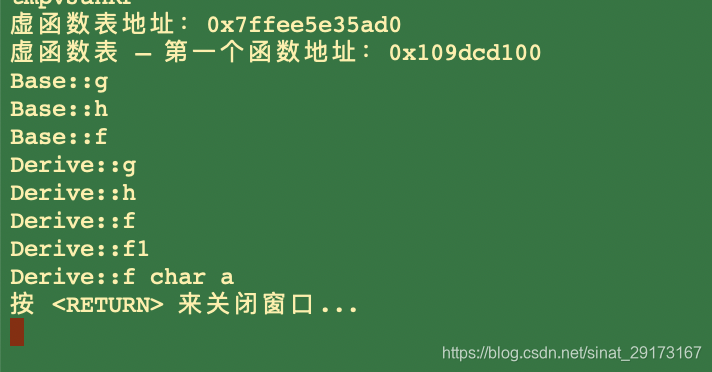
        cout << "虚函数表地址:" << (long *)(&b) << endl;
        cout << "虚函数表 — 第一个函数地址:" << (long *)*(long *)(&b)  << endl;

        // Invoke the first virtual function,3种写法等价。。
        pFun p1 = reinterpret_cast<pFun>(*(long *)(((long *)(&b))[0]));

        auto p2 = (pFun) ((long *) * (long *)(&b))[1];

        pFun p3 = (pFun) * ((long *) * (long *)(&b) + 2);

        p1();
        p2();
        p3();
    }

    {
        Derive d;

        // 打印方法1
        long **table = (long **)&d;

        for (int i = 0; i < 7; ++i) {
            auto pf = (pFun)table[0][i];
            pf();
        }

        /* 打印方法2
        for (int i = 0; i < 7; ++i) {
            auto pf = (pFun)(long)((long *) * (long *)(&d))[i];
            pf();
        }
        */
    }

    {
        // 虽然在Derive虚函数表中有 f1(),但是无法通过父类指针访问没有覆盖的函数
        //Base1 *b1 = new Derive();
        //b1->f1();  //编译出错

    }

    return 0;
}
 🔗
🔗
备份地址: 【使用指针访问虚函数表】