

1. Simulated annealing optimisation method🔗
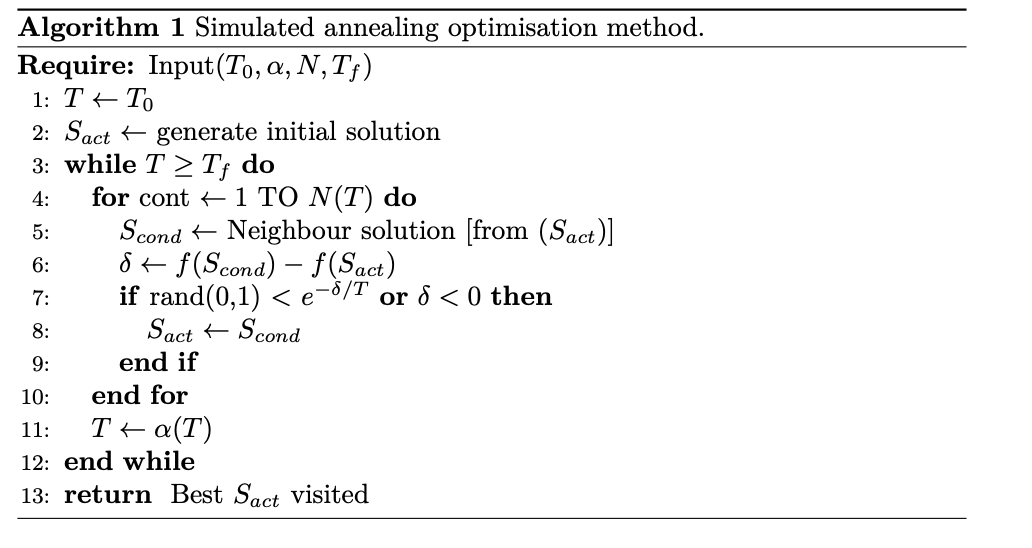
np.random.seed(55)  # For reproducibility

# Section 3.d.1
def eggHolder(x, y):
    return -(y + 47)*np.sin(np.sqrt(np.abs(x/2 + (y + 47)))) - x * np.sin(np.sqrt(np.abs(x - (y+47))))


# simulated_annealing
def simulated_annealing_with_range(initT, alpha, nIter, finalT, range_x, range_y):
    temp = initT
    current = (np.random.uniform(range_x[0], range_x[1]), np.random.uniform(range_y[0], range_y[1]))  # Random initial solution
    best = current

    # Store all solutions as a list of (x,y) tuples
    solutions = []
    solutions.append(current)

    # Store temperature at each iteration
    y_values = np.array([])
    y_values = np.append(y_values, eggHolder(*current))

    while temp >= finalT:
        for _ in range(nIter):
            # 自适应步长:步长随温度缩放,大温度大步探索,小温度小步精修
            sigma0 = 80.0
            neighbor = (
                current[0] + np.random.randn() * sigma0 * (temp / initT) ** 0.7,
                current[1] + np.random.randn() * sigma0 * (temp / initT) ** 0.7
            )
            # 反射进边界
            nx = min(max(neighbor[0], range_x[0]), range_x[1])
            ny = min(max(neighbor[1], range_y[0]), range_y[1])
            neighbor = (nx, ny)

            deltaE = eggHolder(*neighbor) - eggHolder(*current)
            metropolis = np.exp(-deltaE / temp)

            if deltaE < 0 or np.random.rand() < metropolis:
                current = neighbor
                if eggHolder(*current) < eggHolder(*best):
                    best = current

        temp *= alpha  # Cool down

        # Record current solution and value
        solutions.append(current)
        y_values = np.append(y_values, eggHolder(*current))

        # convert to numpy array shape (n_iters, 2) before returning/plotting
    return best, np.array(solutions), y_values


#
best, solutions, y_values = simulated_annealing_with_range(
    1000, 0.9, 1000, 1e-3, (-512, 512), (-512, 512))

print(f"Simulated Annealing Result: x = {best}, f(x) = {eggHolder(*best):.6f}")


# plotting the solutions and temperature over iterations
plt.figure(figsize=(12, 5))
plt.ylabel('Value')
plt.plot(y_values, label='Value')
plt.xlabel('Iteration')
plt.ylabel('Solution Value')
plt.show()
# plt.plot(solutions[:, 0], solutions[:, 1])
# plt.xlabel('X')
# plt.ylabel('Y')
# plt.title('Solutions over Iterations')
# plt.grid()
# plt.show()
2. Tabu search optimisation method🔗
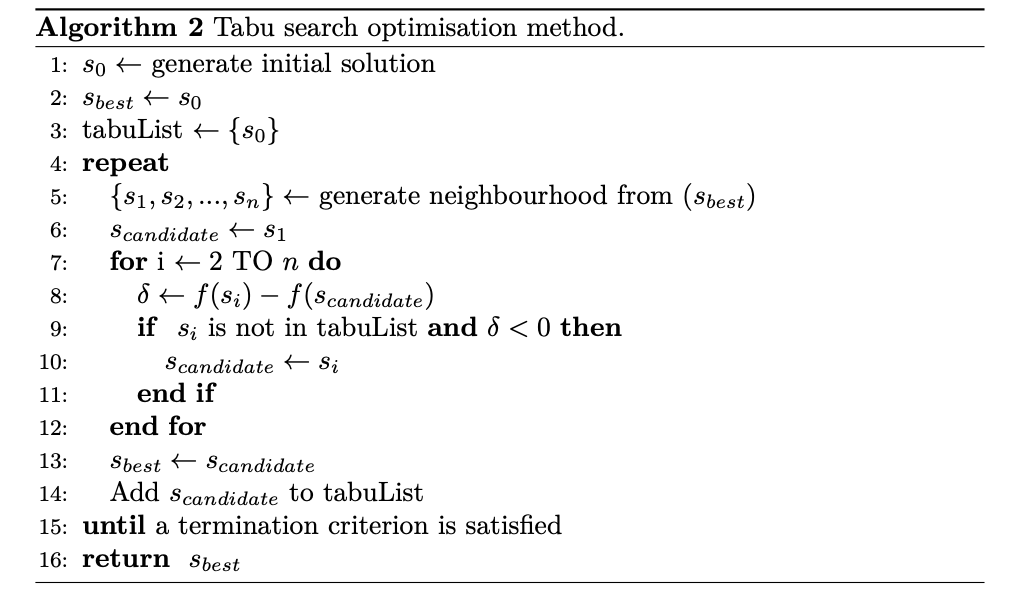
def simulated_tabu_search(neighbor_size, criteria):
    init = np.random.randn() * 10  # Random initial solution
    best = init

    tabu_list = np.array([])
    tabu_list = np.append(tabu_list, init)

    while True:
        neighbors = np.zeros(neighbor_size)
        for j in range(neighbor_size):
            neighbors[j] = best + np.random.randn()  # Generate neighbors

        candidate = neighbors[0]
        for i in range(1, neighbor_size):
            delta = f(neighbors[i]) - f(candidate)
            in_tabu = any(abs(x - t) < 1e-5 for t in tabu_list)
            if delta < 0 and not in_tabu:
                candidate = neighbors[i]

        best = candidate
        tabu_list = np.append(tabu_list, best)

        if f(best) < criteria:
            break
    return best
3. Genetic Algorithm🔗
"""
Created on Fri Jun 27 16:16:14 2025
@author: Francisco
"""

import random


random.seed(42)  # For reproducibility

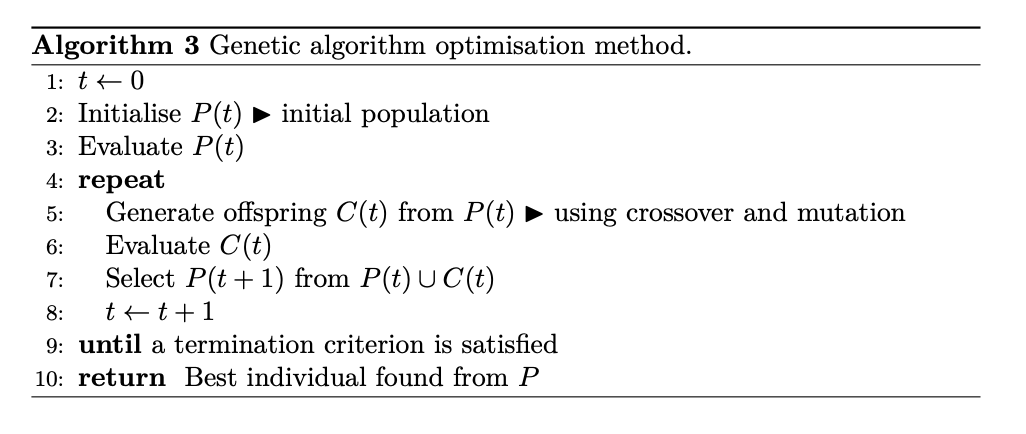
def genetic_algorithm(config):
    #Parameters
    TARGET = config.get("TARGET", "HELLO WORLD")
    POPULATION_SIZE = config.get("POPULATION_SIZE", 100)
    MUTATION_RATE = config.get("MUTATION_RATE", 0.9)
    GENERATIONS = config.get("GENERATIONS", 1000)

    #Generates a random string of a given length
    def generate_individual(length):
        return ''.join(random.choice("ABCDEFGHIJKLMNOPQRSTUVWXYZ ") for _ in range(length))

    #Calculates the fitness of an individual based on how closely it matches the target
    def calculate_fitness(individual):
        fitness = 0
        for i in range(len(TARGET)):
    #        if i < len(individual) and individual[i] == TARGET[i]:
            if individual[i] == TARGET[i]:
                fitness += 1
        return fitness

    #Selects two parents based on their fitness (roulette wheel selection)
    def select_parents(population, fitnesses):
        total_fitness = sum(fitnesses)
        if total_fitness == 0:  # Handle case where all fitnesses are zero
            return random.sample(population, 2)

        rnd1 = random.uniform(0, total_fitness)
        rnd2 = random.uniform(0, total_fitness)

        parent1 = None
        parent2 = None
        current_sum = 0
        for i, individual in enumerate(population):
            current_sum += fitnesses[i]
            if parent1 is None and current_sum >= rnd1:
                parent1 = individual
            if parent2 is None and current_sum >= rnd2:
                parent2 = individual
            if parent1 is not None and parent2 is not None:
                break

        return parent1, parent2

    #Performs single-point crossover between two parents
    def crossover(parent1, parent2):
        crossover_point = random.randint(1, len(parent1) - 1)
        child1 = parent1[:crossover_point] + parent2[crossover_point:]
        child2 = parent2[:crossover_point] + parent1[crossover_point:]
        return child1, child2

    #Mutates an individual by randomly changing characters
    def mutate(individual, mutation_rate):
        mutated_individual = list(individual)
        for i in range(len(mutated_individual)):
            if random.random() < mutation_rate:
                mutated_individual[i] = random.choice("ABCDEFGHIJKLMNOPQRSTUVWXYZ ")
        return "".join(mutated_individual)

    def run_genetic_algorithm():
        #Generate n (POPULATION_SIZE) strings of a given lenght
        population = [generate_individual(len(TARGET)) for _ in range(POPULATION_SIZE)]

        for generation in range(GENERATIONS):
            fitnesses = [calculate_fitness(ind) for ind in population]

            #Check for solution
            best_fitness = max(fitnesses)
            best_individual_index = fitnesses.index(best_fitness)
            best_individual = population[best_individual_index]

            if best_individual == TARGET:
                print(f"Target found in generation {generation}: {best_individual}")
                return

            # print(f"Generation {generation}: Best Fitness = {best_fitness}/{len(TARGET)}, Best Individual = {best_individual}")

            new_population = []
            for _ in range(POPULATION_SIZE // 2):  # Create pairs of children
                parent1, parent2 = select_parents(population, fitnesses)
                child1, child2 = crossover(parent1, parent2)
                new_population.append(mutate(child1, MUTATION_RATE))
                new_population.append(mutate(child2, MUTATION_RATE))

            population = new_population

        print("Genetic algorithm finished without finding the exact target.")
        print(f"Final best individual: {best_individual}, Fitness: {best_fitness}/{len(TARGET)}")